
How Much Should a Small Business Spend on Marketing in 2026?
By Chelsea Light | Founder, Maisona | 4 min read
Setting a small business marketing budget is one of the most common challenges we hear from business owners across Australia. The usual answer is a percentage of revenue. Search for it and you will find the same figure recycled across every marketing blog: spend 5–10% of your revenue.
That number comes from US-centric surveys and consumer-facing industries. It has almost nothing to do with an Australian business selling industrial products or specialist services to other businesses.
Most Australian businesses spend between 2–3% of revenue on marketing, well below global benchmarks. But the fix is not to blindly increase the percentage. It is to spend the right amount on the right things, based on what your business needs to achieve. That starts with having a clear marketing strategy before you allocate a single dollar.
Why the Standard Benchmarks Miss the Mark
The Gartner CMO Spend Survey puts average global marketing budgets at 7.7% of company revenue for 2025, drawing primarily from enterprises with annual turnover above $1 billion. When you run a manufacturing or distribution business with no internal marketing team, that benchmark tells you almost nothing useful.
Australian B2B companies operate in smaller, more concentrated markets. Buyers take longer to make decisions. Customer bases are narrower. And the competitive dynamics differ sharply from a consumer brand selling direct to millions online.
That does not mean 2–3% is the right number either. A $50M distributor spending 2% ($1M) on a well-planned strategy will outperform a $50M distributor spending 5% ($2.5M) on scattered, uncoordinated activity. The budget matters. What you do with it matters more.
Start With the Business Goal, Not the Percentage
The most useful way to set a marketing budget is to work backwards from a commercial target.
Ask: what does the business need marketing to produce this year? Is it 50 new customer accounts? A 20% increase in enquiries for a specific product line? Entry into a new geographic market?
Once you know the goal, you can estimate what it costs to get there. If your target is 50 new accounts and historical data shows roughly 1 in 5 qualified leads converts to a customer, you need 250 leads. Multiply that by your average cost per lead and you have a starting campaign spend figure. Add strategy, content, and management costs on top, and the total budget usually lands between $50,000 and $80,000 for a focused 12-month programme. For a full breakdown of how to build the campaign itself, the Maisona guide to marketing campaign planning covers the process step by step.
That might be 1.5% of revenue for a $50M business or 8% for a $10M business. The percentage follows the goal. It does not lead it. This is the difference between right-sizing a budget and guessing.

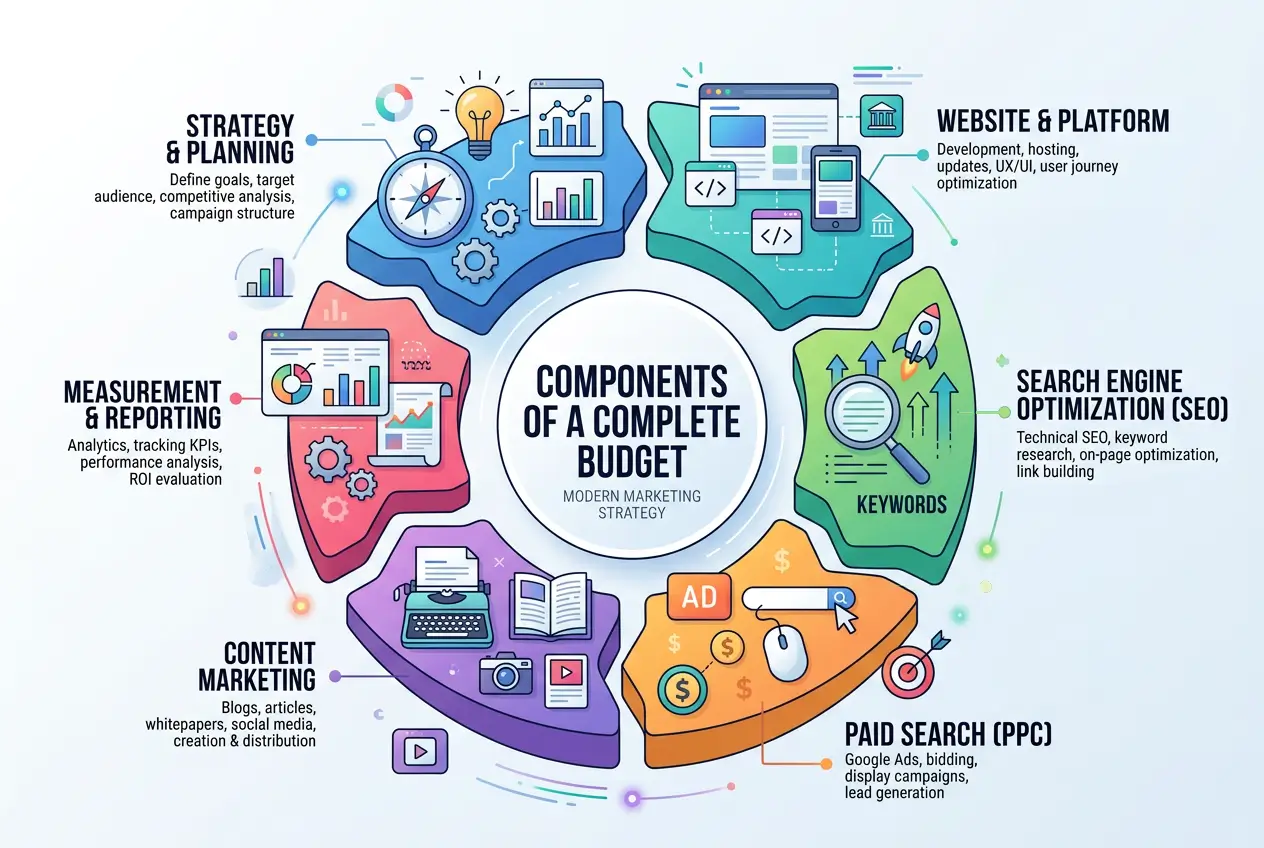
What a Complete Marketing Budget Covers
A marketing budget is not just ad spend. Here is what a complete budget needs to include:
- Strategy and planning: deciding what channels to use, what messages to run, and how the pieces connect. Without this, everything else is guesswork.
- Website: your website is a sales tool, not a brochure. If it does not convert visitors into enquiries, no amount of ad spend will compensate.
- SEO: the highest-ROI channel for most B2B businesses over a 12-month horizon. Maisona’s SEO services are built specifically for construction, industrial, and distribution businesses.
- Paid search: the fastest way to generate qualified leads. Tie your budget directly to lead targets, with room to test in the first 60 to 90 days.
- Content: case studies, technical guides, blog articles. Supports both rankings and your sales team.
- Reporting: track results every month or the budget flies blind.
What you do not need: a rebrand you are not ready for, a presence on five social platforms with no clear audience, or a sponsorship that “builds awareness” without a measurable return.
How to Think About Spend by Growth Stage
If you want a practical benchmark, here is a framework more relevant to Australian businesses than the generic 5–10% rule.
Established businesses (stable revenue, known customer base)
Spend 3–5% of revenue. Focus on retention, positioning, and steady pipeline generation.
Growth-stage businesses (new markets, new product lines)
Spend 5–8%. Growth costs more because you are building awareness where you have no existing traction.
New entrants or new divisions
Spend 8–12% in years one and two to build the digital foundation, website, SEO, and content, that brings down cost per lead over time.
A business spending 4% with a clear marketing strategy will consistently outperform a competitor spending 7% across disconnected agencies and random campaigns.
The Mistake That Costs More Than Underspending
The most damaging pattern is not spending too little. It is spending inconsistently.
The cycle is familiar: a business invests in marketing for six months, generates some leads, then cuts the budget because things are “busy enough.” Six months later, the pipeline dries up and they restart from scratch. Every restart costs more than maintaining momentum would have.
Marketing compounds. SEO rankings build over months. Paid campaigns get more efficient as data accumulates. Brand familiarity grows across multiple touchpoints. Stop-start spending erases that progress every time.
If you can only commit to a modest budget, keep it consistent. A $5,000 per month commitment over 12 months will outperform $30,000 spent in two short bursts with gaps in between.

What Is the Right Marketing Budget for Your Business?
The answer to this question is not a percentage. It is a process.
Start with a commercial goal. Work backwards to the leads and activity you need. Cost that out. Compare it to what you can afford. Adjust scope if needed, but do not abandon the strategy. A smaller, well-planned budget will always outperform a larger one with no direction behind it.
For manufacturers, distributors, and contractors across Australia, the opportunity in 2026 is that most competitors still are not doing this properly. A structured approach puts you ahead of both the underspenders and the unplanned.
Maisona works with growth-focused businesses across Australia and New Zealand. If you want to build a marketing budget tied to real commercial targets, get in touch with our team.
Frequently Asked Questions
What percentage of revenue should a business spend on marketing?
It depends on your growth stage. Established B2B companies typically spend 3–5%. Growth-stage businesses should budget 5–8%. New market entrants may need 8–12% in years one and two. Let the goal set the percentage, not the other way around.
How much do Australian businesses spend on marketing?
Most Australian businesses spend between 2–3% of revenue, which sits below global benchmarks. Whether that is enough depends on your goals and how well you allocate the budget. A well-planned 3% can outperform a poorly managed 7%.
What should a marketing budget include?
Strategy and planning, website maintenance and improvement, SEO, paid search, content creation, and reporting. The strategy and measurement behind your campaigns matter as much as the media cost itself.
Is it better to spend more on marketing or spend more consistently?
Consistency wins. A sustained monthly commitment builds compounding returns through SEO, audience familiarity, and campaign data. Stop-start spending forces you to rebuild from scratch every time, which costs more overall than staying the course.
Do B2B businesses need a different approach to marketing budgets than B2C?
Yes. Longer buying cycles, narrower customer bases, and different channel dynamics mean B2B businesses in sectors like construction and manufacturing get stronger returns from SEO, Google Ads, and content than from broad consumer-facing channels.