
How to Master Marketing Campaign Planning for ROI
By Chelsea Light | Founder, Maisona | 6 min read
Marketing campaign planning sounds simple until you sit down to do it. Most mid-size B2B companies skip it entirely. They pick a channel, set a budget, run some ads, and hope the phone rings. When it doesn’t, they blame the channel.
The channel is rarely the problem. The plan is.
This article walks through how to plan a marketing campaign from start to finish: setting goals that connect to revenue, choosing the right channels, allocating budget, and measuring what matters. If you’re a manufacturer, distributor, or contractor spending money on digital marketing without a structured campaign behind it, this is the process that turns spend into pipeline.

The Real Problem With Most B2B Campaigns
Most marketing campaigns in the industrial space fail for the same reason: they start with tactics instead of strategy.
Someone decides the business needs “more leads” and jumps straight to Google Ads. Or the sales team calls for more “visibility,” so the marketing budget goes to a trade publication ad and a LinkedIn page refresh. Six months later, nobody can point to what the spend produced.
The campaign was never built around a measurable commercial goal. Without that, every channel decision is a guess, every dollar is unaccounted for, and every report is either vague or cherry-picked to look good.
A proper marketing campaign starts with the business outcome and works backwards from there.
Step 1: Set a Goal That Ties to Revenue
“Get more leads” is not a campaign goal. It’s a wish.
A campaign goal needs a number, a timeframe, and a connection to the sales pipeline. For a mid-size manufacturer, that looks like: generate 40 qualified enquiries for Product Line X within 90 days, with a target cost per lead under $150.
That single statement gives you everything you need to plan the rest of the campaign. It tells you how many leads you need, what you can afford to pay per lead, and when you’ll know whether it worked.
If you can’t define the goal in those terms, the campaign isn’t ready to launch. Go back to the commercial team, agree on the target, and build from there. A marketing strategy built around a specific commercial outcome will always outperform one built around a vague ambition.
Step 2: Know Who You’re Talking To
This isn’t about creating a fictional persona with a name and a stock photo. It’s about understanding the actual buying behaviour of the people you’re trying to reach.a
For B2B companies in civil, construction, or mining, the buying process involves multiple decision-makers. The site engineer finds you. The procurement manager checks your pricing. The operations director signs off. According to 6Sense’s 2025 B2B Buying Group research, the average B2B purchase involves around ten people, each independently gathering information before the group reaches a decision. Your campaign needs to reach all of them, not just whoever clicked first.
Before building your campaign, ask:
- Where does each person in the buying chain look for information?
- What questions do they ask before making contact?
- What would make them trust your business over a competitor?
The answers shape your channel selection, your messaging, and your content.
Step 3: Choose Channels Based on the Goal
This is where most campaigns go wrong. Companies pick channels based on what’s popular rather than what fits the goal.
The right channel depends on what you’re trying to achieve:
- Lead generation within 90 days: Paid search is usually the fastest path. You’re capturing people who are actively searching for what you sell.
- Positioning a new product line: Content marketing and targeted LinkedIn campaigns build awareness with a specific audience before they’re in-market.
- Re-engaging warm leads or past customers: Email is more cost-effective and costs a fraction of paid media.
Each goal has a channel that suits it. Running Google Ads for a brand awareness objective wastes money. Running a content campaign when you need leads next month wastes time.
Pick the channels that match the goal, then build the campaign around those channels.
Step 4: Allocate Budget With Clear Logic
Budget allocation shouldn’t come from gut feel. It should flow directly from your goal and your expected cost per result.
Here’s a simple way to think about it. If you need 40 leads and your target cost per lead is $150, your campaign budget is $6,000. If your average conversion rate from click to lead is 5%, you need 800 clicks. At an average cost per click of $7.50, you need $6,000 in ad spend to hit your target.
That’s a rough model, but it gives you a starting framework. You adjust from there based on actual performance once the campaign runs. Maisona’s campaign ROI calculator lets you model these numbers before committing any budget.
Most companies make the mistake of setting the budget first and the goals second. That’s backwards. The budget should serve the goal, not the other way around.
Also, leave room for testing. Allocate 10 to 15% of the campaign budget to testing different ad copy, landing pages, or audience segments. The first version of anything is rarely the best-performing version. Spend everything on your first setup and you have nothing left to improve with.
Step 5: Build the Campaign So It Actually Connects
A campaign isn’t just an ad. It’s the ad, the landing page, the follow-up, and the sales conversation. Every piece needs to match.
- The ad copy should reflect the landing page.
- The landing page should deliver on the promise the ad made.
- The form should be short enough that people fill it out.
- The follow-up should happen within minutes, not hours.
For B2B manufacturers and distributors, this is where most leads disappear. The ad works. The click happens. But the landing page is a generic homepage, the form asks for 12 fields, or the lead sits in an inbox for a week before anyone calls.
That last point matters more than most businesses realise. Research on speed-to-lead response rates shows that responding to an inbound enquiry within five minutes makes you 21 times more likely to qualify the lead than waiting just 30 minutes. The campaign itself is only half the equation.
Before launching, walk through the campaign as the buyer would. Click the ad. Read the page. Fill out the form. Check what happens next. Fix anything that feels slow or disconnected before you spend a dollar.
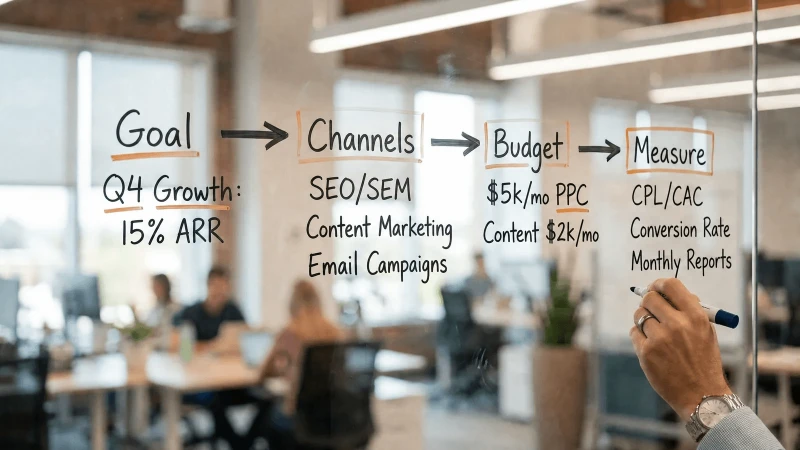
Step 6: Measure What Matters and Adjust
Once the campaign goes live, track the metrics that connect to your original goal. For a lead generation campaign, the numbers that matter are:
- Cost per lead
- Lead quality (are they in-market and in your target segment?)
- Conversion rate by channel
- Pipeline contribution (how many leads turned into quotes or sales?)
Vanity metrics like impressions and click-through rate help diagnose problems, but they’re not success metrics. A campaign with a 10% click-through rate and zero qualified leads is a failure. A campaign with a 2% click-through rate that produces 40 qualified leads at $120 each is a win.
Review performance weekly for the first month, then fortnightly. Make changes based on what the data shows, not what you assumed would work. Kill underperforming ads early. Double down on what’s converting. Shift budget between channels when one outperforms another.
Report the full picture. If something isn’t working, say so and explain what you’re changing. That’s how you build trust with stakeholders and improve the next campaign.
Build the Plan Before You Spend the Budget
A marketing campaign that delivers ROI doesn’t come from good creative or a big budget. It comes from a structured plan that connects a commercial goal to the right channels, the right spend, and a measurement framework that keeps everyone honest.
For mid-size manufacturers, distributors, and contractors, this kind of planning separates marketing that generates revenue from marketing that generates reports.
If your team doesn’t have the capacity to plan, execute, and measure campaigns at this level, that’s exactly the gap a full-service partner fills.
Maisona works with growth-focused businesses in construction, industrial, and B2B sectors across Australia and New Zealand. Talk to our team about what a strategy-first campaign looks like for your business.
Frequently Asked Questions
How much should a B2B company spend on a digital marketing campaign?
Set the budget from the goal, not the other way around. Calculate your target number of leads, multiply by your acceptable cost per lead, and that gives you a starting figure. For most mid-size B2B companies, a focused campaign can start from $3,000 to $10,000 in media spend per quarter, depending on the market and competition.
How long does it take for a marketing campaign to show results?
Paid search campaigns typically start generating leads within the first two to four weeks. SEO-driven campaigns take longer, usually three to six months to build momentum. The key is setting a realistic timeframe at the planning stage and measuring against it, not pulling the plug after two weeks.
What is the most effective digital marketing channel for B2B lead generation?
For most B2B companies in manufacturing, construction, and industrial services, paid search (Google Ads) is the fastest path to qualified leads because it targets people who are actively searching for your products or services. SEO delivers stronger results over time but requires a longer runway.
How do you measure marketing campaign ROI?
Track cost per lead, lead quality, conversion rate by channel, and how many leads progress to quotes or sales. Compare total campaign cost against the revenue those leads generated. Impressions and clicks help with diagnosis but won’t tell you whether the campaign made money.