Losing clicks to AI Overviews? Here’s What to Do About It
By Gavin Jones | Head of Digital, Maisona | 6 min read
Are You Losing Clicks to AI Overviews?
You’ve done the work. Your content ranks. But your traffic is down. Sound familiar? If your organic traffic has softened over the past year and you haven’t been given a clear explanation, Google’s AI Overviews might be a significant part of the story.
Traffic loss from AI Overviews varies by query type, but multiple studies show organic click-through rates can decline by 20–60% when AI-generated summaries appear. Informational and top-of-funnel searches are the most affected, as users often get complete answers without clicking through to websites.
What we are seeing
- AI Overviews are changing search from a click-based model to an answer-based model
- Google is answering more queries directly in search results
- Informational content is being hit the hardest
- To adapt, brands must optimise for: AI visibility (being cited), entity authority, and conversion beyond the click
SEO is no longer just about rankings, it’s about being referenced, trusted, and summarised by AI systems.
Core Click-Through Rate Impacts
| Metric | Statistic | Source |
|---|---|---|
| AI Overviews reduce CTR by 58% | For position #1 rankings; for every 100 previous clicks, now only 42 remain | LLMrefs |
| Organic CTR plummeted 61% | From 1.76% → 0.61% for queries with AI Overviews | Dataslayer |
| CTR drops from 15% → 8% | When AI Overview is present vs. absent | BusySeed |
| Paid CTR crashed 68% | From 19.7% → 6.34% for queries triggering AI Overviews | Dataslayer |
Zero-Click Search Stats
| Metric | Statistic | Source |
|---|---|---|
| >80% of searches end without a click | Up from 75% in 2024 | LLMrefs (Feb 2026) |
| 93% of AI Mode searches = zero click | More than double AI Overviews' 43% zero-click rate | Semrush |
| 92–94% zero external clicks | For informational queries ("what is," "how to") in AI Mode | LLMrefs (Feb 2026) |
| 60% of traditional searches = zero click | Due to AI summaries satisfying intent | Ekamoira |
What Are AI Overviews?
AI Overviews are AI-generated summaries that appear at the top of Google’s search results, pulling information from multiple web sources to deliver a direct answer before the user ever reaches traditional organic results.
The consequence is straightforward: users increasingly get what they need without clicking anything. For businesses that depend on informational content to drive traffic, this represents a genuine and growing challenge.
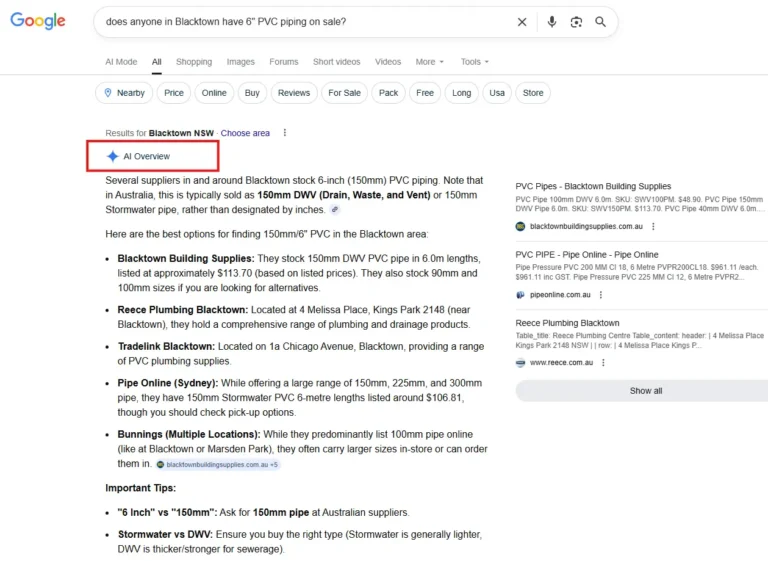
More significantly, AI Overviews are reshaping how people search altogether. Traditional queries were short and keyword-driven , e.g. “PVC pipe supplier Blacktown.” But as users learn that more conversational, specific questions yield instant, cited answers, their behaviour is shifting. That same search now looks more like “does anyone in Blacktown have 6” PVC piping on sale?” a natural language query that returns direct responses, sourced offers, and relevant details in one shot.
In short, AI Overviews aren’t just changing where traffic goes, they’re changing the intent and structure of search queries themselves.
What Is The Real Impact of AI overviews?
- Users get answers in aggrate instantly
- Getting the answer requires fewer scrolls
- Trusted sources of information are getting citied
What This Means for Your Strategy
- Create Content Worth Citing: AI Overviews pull from credible, well-structured, authoritative sources. If your content is cited inside an AI Overview, you still get brand visibility and often a link. The goal isn’t just to rank anymore. It’s to be the source. This means writing content with clear, declarative answers to specific questions. Structured headings. Well organised sections. Real expertise that an AI system can recognise and reference.
- Shift Weight Toward Commercial Content: Bottom-of-funnel content – case studies, product comparisons, service-specific pages, local content is far more resilient to AI Overviews because these queries require specific, personalised answers that AI can’t fully provide. If your content strategy is too heavy on awareness-stage articles, now is a good time to rebalance.
- Build for the Full Search Ecosystem: Google is one part of the picture. AI tools, YouTube, LinkedIn, Reddit, and industry forums are all discovery channels now. An integrated content strategy distributes your authority across multiple surfaces – so you’re not entirely at Google’s mercy.
The 3-Part Strategy to Win in an AI Search Landscape
- Visibility (Be Included in AI Answers)
– Use clear headings and structured formatting
– Answer questions directly and concisely
– Add definition-style content blocks - Citations (Become a Trusted Source)
– Fact-based content
– Statistics and data
– Clearly explained concepts - Conversion (Capture Value Beyond the Click)
– Make every visit count
– Offer high-value content (guides, tools, downloads)
– Build brand recognition – even without clicks
This strategy includes using techniques that can improve your chances of being citied, proven tactics like using Schema, answering questions directly, adding supporting statistics and evidence, along with clear definitions, structure headings (H1,H2,H3) and the use of bullet points and lists.
The Question to Ask Your Agency