
Winning Government Tenders Starts Before the RFT
By Gianna Stead | SEO Manager, Maisona | 5 min read
Winning government tenders in civil and construction rarely turns on the submission itself. By the time you’re writing it, someone has already decided you were worth inviting. That decision happened weeks earlier, using information you probably never checked.
Most of the effort in a tender goes into the response document. Almost none goes into the fortnight before the invitation lands. Work disappears in that fortnight without anyone in the business noticing.
Selective Tendering Picks You Before You Bid
Government construction work in NSW moves through prequalification schemes, and your tendering strategy and positioning decides whether you sit on the list agencies draw from. Miss the list and the opportunity never reaches you.
Take SCM1461, the scheme covering construction work valued between $1 million and $9 million. Agencies buying under it seek submissions from a minimum of three prequalified suppliers instead of advertising to the open market. The buy.nsw scheme guidance names four criteria they apply: legal capacity, financial capacity, commercial ability and technical ability.
Contractors underestimate what that means day to day. Prequalification puts your ABN in a searchable list beside hundreds of others holding the same work categories. Someone still has to pick three names off it. They do that fast, usually with a browser open in the next tab.
Ask your estimator how many invitations arrived last quarter. Then count how many projects in your categories went to tender in the same period. The gap between those two numbers is a positioning problem, and no amount of submission polish will close it.
Check your category list while you are in there. Plenty of contractors hold prequalification in categories they stopped chasing three years ago, and none in the category their best two projects sit in. Nobody audits that field after the initial application.
If you tender across the Tasman, check the panel and supplier arrangements each New Zealand agency runs, because the invitation mechanics vary more than the evaluation criteria do.
Price Is Not the Only Thing Being Scored
The Commonwealth Procurement Rules on value for money put this in writing. Price is not the sole factor in a value for money assessment, and officials must weigh the non-financial costs and benefits of each submission alongside it. Their criteria include fitness for purpose, whole-of-life costs and the supplier’s relevant experience and performance history.
Sit with that last one for a moment. Your experience and performance history carry formal weight in the scoring, which means an evaluator has to reach a view about work you already delivered. They build that view from whatever evidence they can find and verify without ringing you.
For construction services above $7.5 million, officials also consider the economic benefit of the procurement to the Australian economy. Local employment, local supply chains and regional delivery capability all become scoreable. Most contractors bury that material in one paragraph on an About page.

What a Procurement Officer Finds When They Search Your Name
Someone building a shortlist will search your company name. What loads in the next ten seconds does more work than the capability statement you spent a fortnight on.
Here is what they check, roughly in this order:
- Whether you have delivered projects of similar scale, type and complexity
- Whether your safety, quality and environmental accreditation is current and visible
- Whether your recent work is recent, or whether the newest project dates from 2022
- Whether the business looks stable enough to carry retention and progress claims
- Whether anyone on your leadership team is findable and credible
Similar scale, type and complexity is doing heavy lifting in that first line. A council carpark and a bulk earthworks package can both be $3 million jobs with nothing else in common. Evaluators want a project that looks like theirs, which is why one well-documented job in the right category beats a gallery of twenty in the wrong one.
Answer all five inside a minute and you make the shortlist decision easy. Give them a photo gallery with no captions and a services list, and they move to the next name.
None of that is a website problem in the design sense. It is an evidence problem. The information already exists inside your business, sitting in close-out folders and safety management systems. Nobody has ever been asked to publish it.
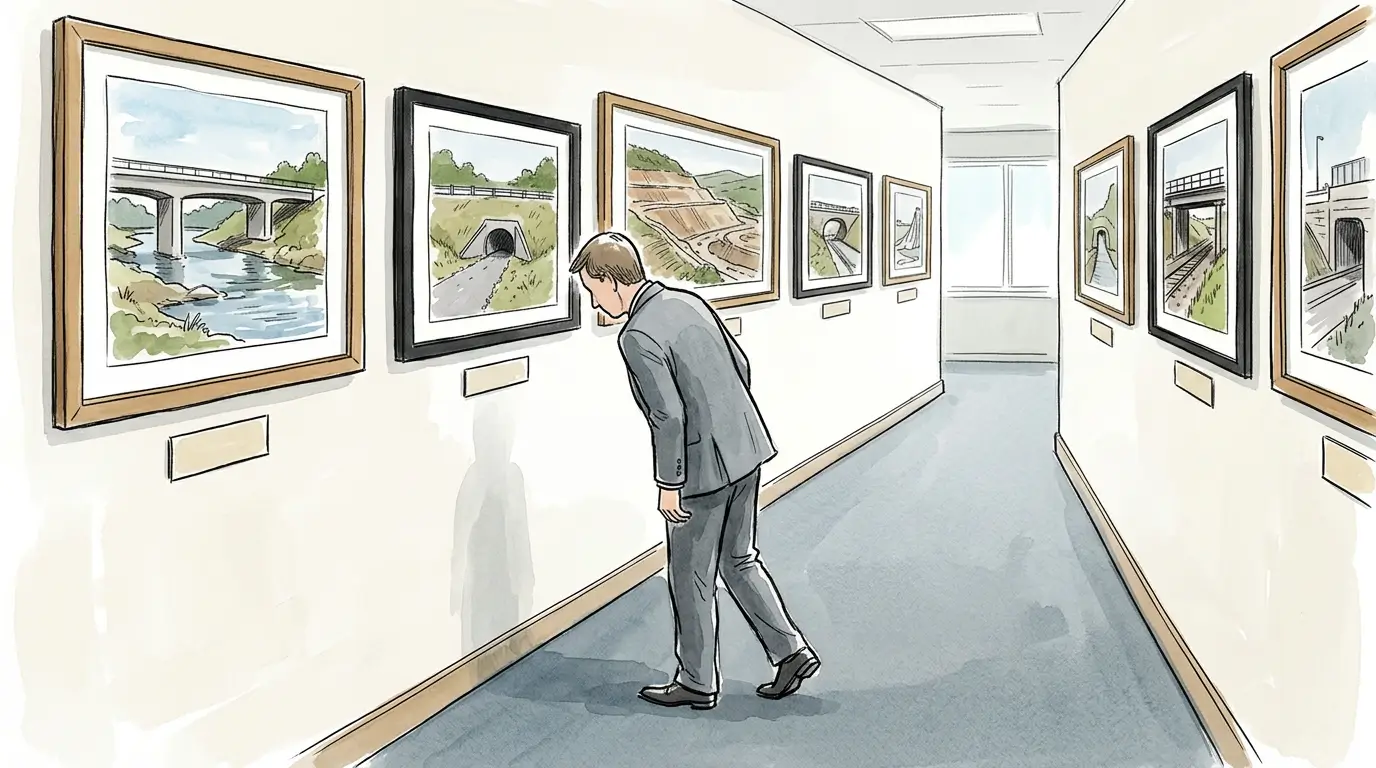
Your Project Evidence Does the Work a Capability Statement Can't
Your capability statement gets read once, by whoever you emailed it to. Project pages keep working long after that. Evaluators you never spoke to read them, along with subcontractors sizing you up and the AI systems that assemble an answer when a buyer asks which contractors handle water infrastructure in western Sydney.
Build one page per significant project. Give each page the details an evaluator needs in order to score you:
- Client and delivery model, whether construct only or design and construct
- Contract value band and delivery timeframe
- Scope written in the language your scheme categories use, not marketing language
- Constraints you worked around, such as live traffic, heritage fabric or restricted access
- A named outcome, delivered on programme, zero lost time injuries, or the actual figure
Write each page so a single section can be lifted out and still make sense alone. The same discipline sits behind getting cited in AI models. An evaluator skimming for evidence and a language model assembling an answer both want a self-contained chunk that survives being pulled out of context.
Two practical notes on this. Photographs of your own site work beat stock imagery by a distance, and buyers in this sector spot the difference immediately. Date every project publicly, because an undated case study reads as old whether it is or not.
If you are the stretched marketing person reading this with three other jobs on today, protect one habit above everything else. Publish a project page at close-out, every time, while the photographs and the figures are still in someone’s phone. The rest can wait.

Five Fixes Worth Doing Before Your Next EOI
Work through these in order. Most teams clear the first three inside a fortnight.
- Audit live project pages against every scheme category you hold prequalification in, then fill the gaps
- Publish current ISO 9001 and ISO 45001 certificates on a page a buyer finds without asking
- Add visible dates to every project page and case study
- Give your two most senior delivery people a real profile with project history, not a headshot and a job title
- Set a close-out trigger in your project management system that assigns the write-up before the final claim goes out
One caution across all of it. Treat this as a strong default and check the pattern against your own invitation data before committing a quarter to it. A business winning steadily through relationships with three councils has a different problem to one chasing Tier 1 panels.
The submission still matters. It decides between the companies who were already worth inviting, and the work that puts you in that group happens months earlier, in public, where you control it.
If your invitation volume has flattened while your prequalification categories have not changed, Maisona can audit what a procurement officer finds when they search you, and show you what is missing. Talk to our team about what tendering positioning looks like for your business.
Frequently Asked Questions
What is selective tendering in NSW government construction?
Agencies buy from prequalification schemes instead of advertising openly. Under SCM1461, which covers construction work valued between $1 million and $9 million, an agency invites submissions from a minimum of three prequalified suppliers rather than running an open call.
Does the lowest price win a government tender?
No. The Commonwealth Procurement Rules state that price is not the sole factor in a value for money assessment. Officials must also weigh fitness for purpose, whole-of-life costs and the supplier’s relevant experience and performance history.
What do procurement officers check before inviting a contractor to tender?
Similar project scale, type and complexity, current safety and quality accreditation, how recent your published work is, financial stability sufficient to carry retention and progress claims, and whether your delivery leadership is findable and credible.
How do I get prequalified for NSW government construction work?
Apply through the relevant buy.nsw scheme for your work value band. You need an ABN and you need to meet the legal, financial, commercial and technical standards the scheme sets out.
What should a construction project page include?
Client and delivery model, contract value band and timeframe, scope written in scheme category language, the constraints you worked around, and a named outcome. Write each section so it makes sense when read on its own.